
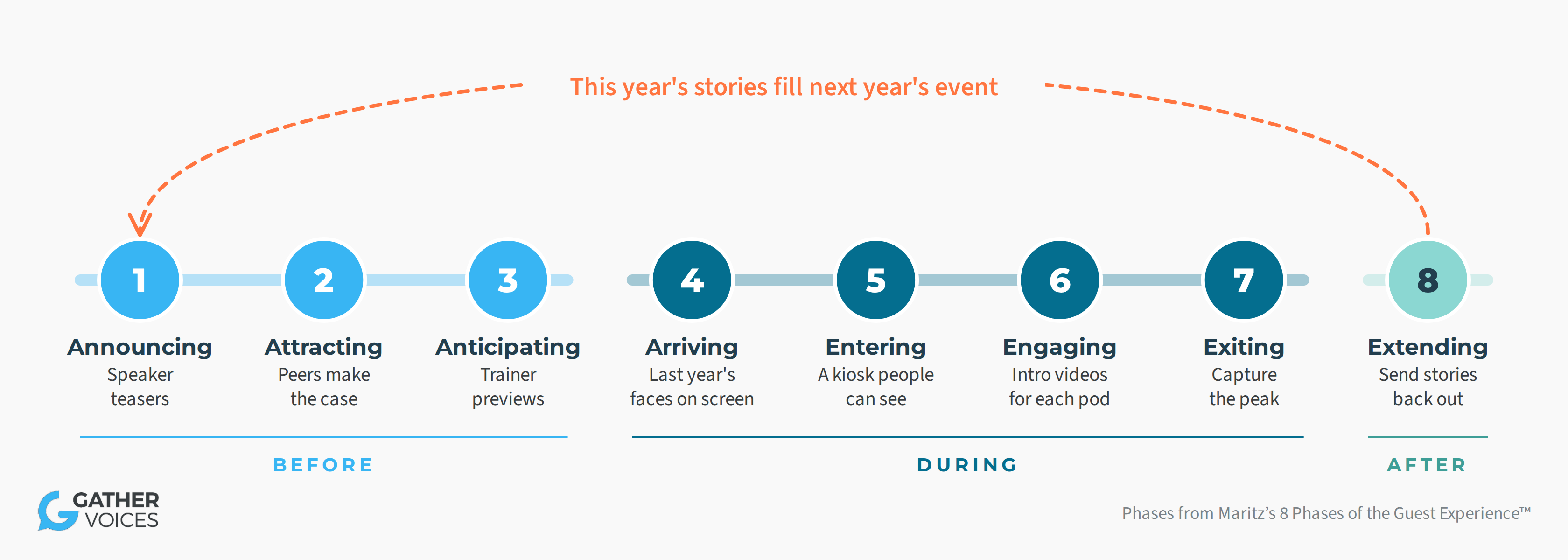
Every event has eight points where an attendee decides something: whether to register, which session to pick, whether the event was worth it, and whether to come back next year.
Maritz mapped those points in its ebook, How to Create a Powerful Event Journey Using Behavioral Science That Works. It splits every event into eight phases, from the first announcement to the memories people carry home, and pairs each phase with a principle from behavioral science. Set it next to the videos our clients collect, and one pattern repeats: at almost every phase, the person your attendee listens to most is another attendee.
Phase 1: Announcing. Maritz pairs this phase with the Teasing Effect. People enjoy an experience more when something is held back, as long as the reveal lives up to the tease. A 60-second speaker video sharing one idea from a session does both jobs. ACRP asked more than 100 speakers to record teasers and share them with their own networks. The videos drew more than 59,000 views, sent 2,500+ people to the registration page and helped lift registrations 12%.
Phase 2: Attracting. This is social proof: when people are unsure, they follow people like them. Maritz is clear about its limits: "Social proof only works when it's authentic and specific." The Association of Fundraising Professionals asked board members to record their favorite ICON moments from home. Those videos ran across email and social before the conference, and ICON finished 18% above its attendance goal.
Phase 3: Anticipating. Choice overload sets in when every option looks the same on paper. TASBO markets 20+ academies and workshops a year. Instead of writing more session copy, it asked trainers to record a short preview of each one. Those video emails earned a 300% higher click-through rate than TASBO's text campaigns, and attendance grew 10% year over year.
Phases 4 and 5: Arriving and entering. Priming says small cues shape how people feel before anything starts. Operational transparency says people trust what they can watch being made. Loop last year's attendee videos on the screens near registration, so the first faces people see are their peers. Then put your video kiosk where traffic flows. Once someone watches a colleague record in 90 seconds, it stops looking like a big ask.
Phase 6: Engaging. Maritz's principle here is Conversations of Four: in groups of four, everyone gets a turn without the group getting too big to follow. Their suggestion is to swap theater-style rows for small pods. Short attendee intro videos, collected before the event and played on the main screens before a session, give each pod somewhere to start.
Phase 7: Exiting. The Peak-End Rule says people judge an experience by its most intense moment and by how it ends. That's when to ask for a story. The American Association of Orthodontists placed a kiosk in a high-traffic area of its Annual Meeting, added a gamified activation and collected 80+ videos in three days. The Institute for Educational Leadership gathered 99 videos in two days at its 2026 conference. Keep your prompts to one or two questions. Choice overload applies to the person recording, too.
Phase 8: Extending. Maritz ties the last phase to the Endowment Effect: "People value what they help create, and they remember what feels like theirs." Their warning is that generic follow-up falls flat. A member telling their own story on video is about as personal as follow-up gets.
The Emergency Nurses Association captured 70+ member stories in four days from a kiosk in its member lounge, enough to fill a 12-month content calendar. IEL took its 99 videos into grant proposals, board decks, sponsorship outreach and promotion for its 2027 conference.
The simplest step after any event: send every contributor their video within a week, with a thank-you and a link to share it.
Maritz draws the eight phases as a circle, and the last phase feeds the first. The stories you capture at this year's event become the social proof in next year's registration emails.
ASAE has collected 1,600+ member and staff videos over five years, 800+ of them at events. Cvent has captured 400+ videos over four years of CONNECT, including 100 in three days in 2025. Those stories keep its campaigns running all year.
Write the eight phases down the side of a page. Next to each one, note where you use speaker, member or attendee voices today. Most teams find one or two phases covered and gaps in the rest.
Those gaps are where we can help. Book a 30-minute planning call with the Gather Voices team and we'll go through your map with you, phase by phase. You'll leave with a short list of the two or three places where peer video would do the most for your next event, and examples from organizations like yours that have already done it.
October and November are the best time to have this conversation, while 2027 budgets and plans are still open.


