
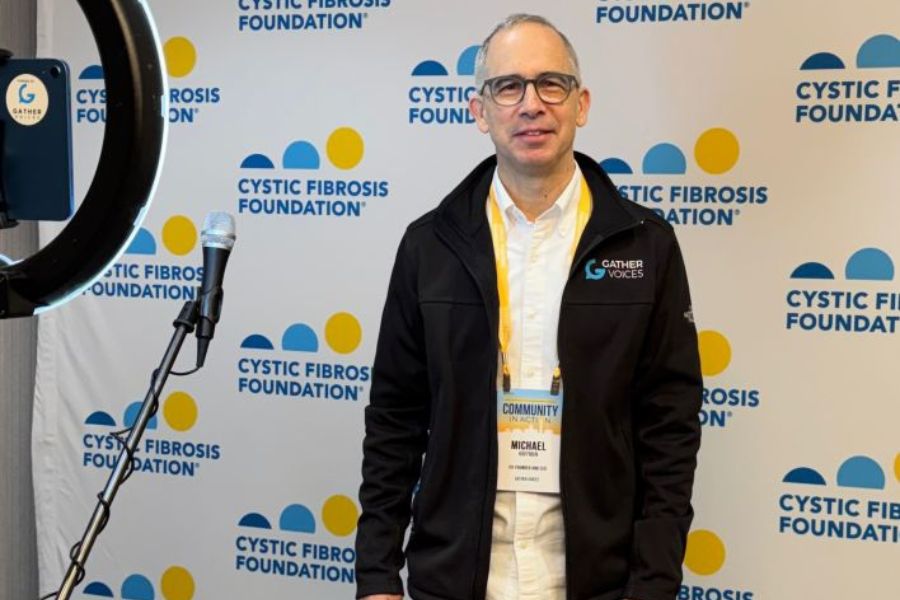
I just spent three days in Washington, D.C. working with the Cystic Fibrosis Foundation — supporting their March on the Hill and Volunteer Leadership Conference by helping them collect video stories from their community. In roughly 36 hours of active collection, we gathered more than 50 videos. I’ve done this work for a long time, across hundreds of organizations. But I am still sitting with what I heard in those stories.
People spoke of children they lost. They spoke of diagnoses that arrived before their kids even made it to elementary school — because for most of the Foundation’s history, that’s all the time CF gave them. And they spoke of hope. Real, evidence-based, earned hope.
That contrast — grief and hope, side by side, in the same 90 seconds — is something I want to think about for a while.
I knew the broad outlines of CFF before this week. But spending time inside their community pushed me to go deeper, and what I found is genuinely remarkable.
When the Cystic Fibrosis Foundation was established in 1955, people born with CF weren’t expected to live to attend elementary school. The organization was founded by a group of concerned parents, determined to save the lives of their children. That’s the founding story. Not a board of doctors. Not a corporate initiative. Parents who refused to accept what they were told.
What’s happened since is one of the more extraordinary organizational stories in American nonprofit history — and most people outside the health advocacy world have never heard it.
By the late 1990s, CF drugs existed that managed symptoms, but nothing addressed the underlying cause of the disease. By 1998, the median predicted age of survival for a person with CF was 32 years, and people with CF and their loved ones were desperate for faster progress.
The Foundation made a decision that most nonprofits would never have the nerve to make. Instead of distributing grants and hoping for the best, they built what they call a venture philanthropy model — providing upfront funding to pharmaceutical companies to help reduce the financial risk of developing drugs to treat CF. They became, in effect, a biotech investor with a mission.
They found a then-small biotech called Vertex Pharmaceuticals willing to take on a disease most companies considered too rare to bother with. In the late 1990s, encouraged by then-President Robert Beall, the Foundation began investing in Vertex — when it was a small start-up — in the form of venture philanthropy. The total investment amounted to $150 million.
The bet paid off in a way that almost defies description. In 2012, the FDA approved ivacaftor (Kalydeco) — the first drug to address the underlying cause of CF. And then: in 2014, the Foundation sold royalty rights for CF treatments developed by Vertex for $3.3 billion to Royalty Pharma — bringing resources to the fight against CF never thought possible. That was twenty times the Foundation’s entire 2013 budget.
They didn’t stop. In 2020, they secured additional resources when they completed a sale of their remaining stake in royalties related to Vertex’s therapies for an upfront payment of $575 million and a potential future payment of $75 million.
The result of all of this? Data from the 2021 CF Foundation Patient Registry shows that the predicted median survival rate is now 53 years old — up from 37 years old a decade ago. For babies born with CF between 2020 and 2024, the Foundation’s projection is that half will live longer than age 65.
Let that sink in. The children of the parents who founded this organization in 1955 weren’t expected to finish elementary school. Children born with CF today are being told to expect to reach retirement age.
Numbers don’t cry. People do.
The volunteers I met this week were parents and siblings and people living with CF themselves. But one person inspired me and made me think about my own commitment to this work. They have no DNA connection to CF — no family member with the disease, no personal diagnosis. They simply learned about the organization, dug into its history, understood how it operated, and decided they wanted to be part of it. Now they sit on a local board. They fundraise. They came to Washington to walk the halls of Congress.
They made a video, and in it they explained exactly why. They were inspired by what this organization is — by the model, by the mission, by the proof that it works.
I understood that completely. It’s exactly why I’m writing this.
The rest of the volunteers came with CF in their family or their body. They came to Washington to make the case for continued NIH funding, for FDA support, for the infrastructure that makes this science possible. The Foundation launched March on the Hill in 2007 to educate elected officials about the need for continued funding for NIH, the FDA, and other drug development and research programs. This year, the theme was affordability. All this drug discovery is wonderful but only if the patients can afford to get it.
What’s remarkable is that they show up not just as advocates asking for help — they show up as people who have watched what sustained investment can actually do, and who are fighting to make sure it continues.
The stories they shared on video were layered. A parent describing a child they lost — and then, in the same breath, describing how their other child did not face the same fate because of the work this community has done. That’s not a talking point. That’s a person who has processed something devastating and converted it into action.
This is what authentic advocacy looks like, and why I’ve spent the last decade building tools to capture it.
Why this work matters to me
At Gather Voices, we believe the most powerful communication any organization can do is to surface the real voices of the people connected to its mission. Not polished testimonials. Not media training. Human beings saying true things.
There’s a version of “video storytelling” that is mostly marketing. Interview someone in good lighting, ask them a question with the answer baked in, edit it to 45 seconds. That’s fine. It serves a purpose.
What the Cystic Fibrosis Foundation’s community produces is something different. When someone speaks about a child they buried, or describes the moment they learned that a new drug had extended their own life expectancy by decades, you are not watching a content asset. You are watching a person tell the truth about what has happened to them.
Fifty-plus videos in a day and a half. Every single one carrying that weight.
I’ve been in this work long enough that I thought I was beyond being surprised by what video storytelling can do. The CFF community reminded me I was wrong.
A lot of nonprofits talk about innovation. The Cystic Fibrosis Foundation actually did it — they restructured how a disease gets funded, took the financial risk themselves, and turned a death sentence into a chronic condition for most of the people it affects. They did it without losing the community of parents and patients and siblings who have been the heart of the organization since 1955.
The Foundation now has over 80 chapters and offices across the United States, and the volunteers I met this week weren’t there because someone sent them. They were there because they have skin in the game in the most literal sense.
That combination — organizational courage at the strategic level, and genuine human investment at the community level — is rare. Most organizations have one or the other. CFF has both.
I’m grateful I got to spend a few days inside it. And I’m grateful that the work we do at Gather Voices plays some small role in helping them tell their story.
---
Michael Hoffman is the CEO of Gather Voices, a video collection and storytelling platform.


