

What makes a donor pause, feel inspired, and open their wallet? Effective fundraising appeals don’t just ask for money. They connect with donors on a deeper level and make them feel like an instrumental part of your mission.
While crafting a donation request can seem challenging, there are a few key components that work together to create an effective framework. In this quick guide, we’ll break down four essential factors that every strong fundraising appeal must have to engage donors, make them feel valued, and inspire them to take action.
Begin by explaining the specific problem or challenge your nonprofit addresses, whether it’s a cause, crisis, or ongoing need. This could be your mission as a whole or a specific aspect of it that needs special attention. For instance, imagine you work at a nature center that just launched a wildlife rehabilitation program. While you need donations year-round to support the rest of your programs, your most immediate need is securing initial funds to build a facility and purchase specialized supplies.
That need should be the focus of your fundraising appeal. Emphasize urgency and highlight the potential consequences of not taking action. For instance, you might share that you just took in an injured owl named Hoo-dini who has a broken wing and needs urgent medical attention.
Your donors want to play a role in your nonprofit’s story, so emphasize how they can help solve the problem. Let them know their support makes a tangible difference in addressing the issue. For instance, you might say their generosity will help purchase vital medical equipment to save Hoo-dini’s life.
When it comes to donor communications, understanding your target audience is key. By knowing who you’re speaking to and what they care about, you can craft present your problems in a way that will stir emotions and inspire action.
While evoking emotion can be enough to encourage donations, most donors want to know about your nonprofit’s impact before giving. In fact, 67% of donors want to know details about how their contributions will be used to prove their money is being put to good use.
When it comes to showing impact, there are two types of data: quantitative and qualitative. While quantitative data is anything you can assign a number to, qualitative data is descriptive and focuses on the experiences and personal outcomes that your work creates.
With that in mind, consider incorporating data into your fundraising appeals by:
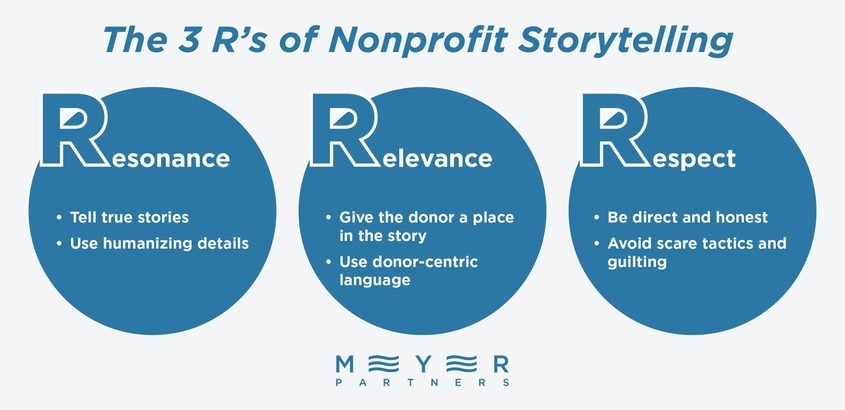
Image Alt Text: The three R’s of nonprofit storytelling are resonance, relevance, and respect.
Data adds legitimacy to your fundraising appeals. Backing up your requests with real numbers and stories shows that your nonprofit has made and will continue to make a difference.
Once you’ve tugged on donors’ heartstrings, issue a targeted call-to-action (CTA) to tell them exactly how to help. Include suggested donation amounts with impact statements to provide a frame of reference for how much is needed to make an impact.
Bloomerang’s donation page guide provides an excellent example of suggested giving amounts from The Nashville Food Project:
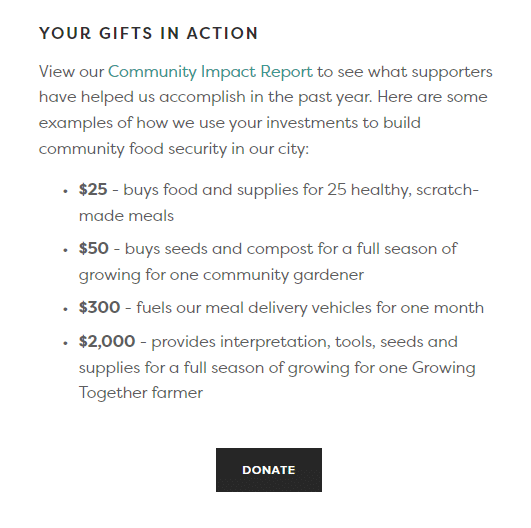
Image Alt Text: A list of suggested donation amounts with impact statements for The Nashville Food Project
Root the amounts in real data based on what your nonprofit has historically achieved. Public appeals, such as those on social media, can’t be customized to individual donors, but you can base suggested giving amounts on your organization’s averages.
When sending appeals directly to donors, personalize each ask based on the donor’s giving history and preferences. For instance, you wouldn’t ask someone who has historically given around $50 for a $500 donation. Stewarding donors through personalized asks based on their previous contributions indicates you recognize and value their support.
To encourage immediate action, introduce a deadline in your fundraising appeal. Let’s say a generous major donor or corporate partner issued a matching gift challenge, promising to match all contributions within a certain timeframe. You might include urgent language to emphasize that, such as “Double your impact if you donate by Friday.”
There’s more than one way to support your nonprofit’s work! While one supporter might give $50 to your campaign, another could bring in hundreds in donations just by sharing one of your video appeals with their network.
Make sure donors know about various other ways to support you by emphasizing those opportunities in your fundraising appeals. Give them the flexibility to choose how to get involved and boost your nonprofit’s financial stability. Highlight the following ways to show support:
After reading your fundraising appeal, a supporter should feel compelled to give. By providing multiple ways to show support, you ensure that every donor—whether they can give financially or not—can help further your mission, making them more likely to take action.
A compelling fundraising appeal has the power to convert passive interest into real action. Whenever someone gives, follow up with an appropriate level of recognition, whether that’s sending an email, adding them to your donor wall, or calling them. Start working on your approach so you can inspire supporters to become lifelong advocates for your cause.


