
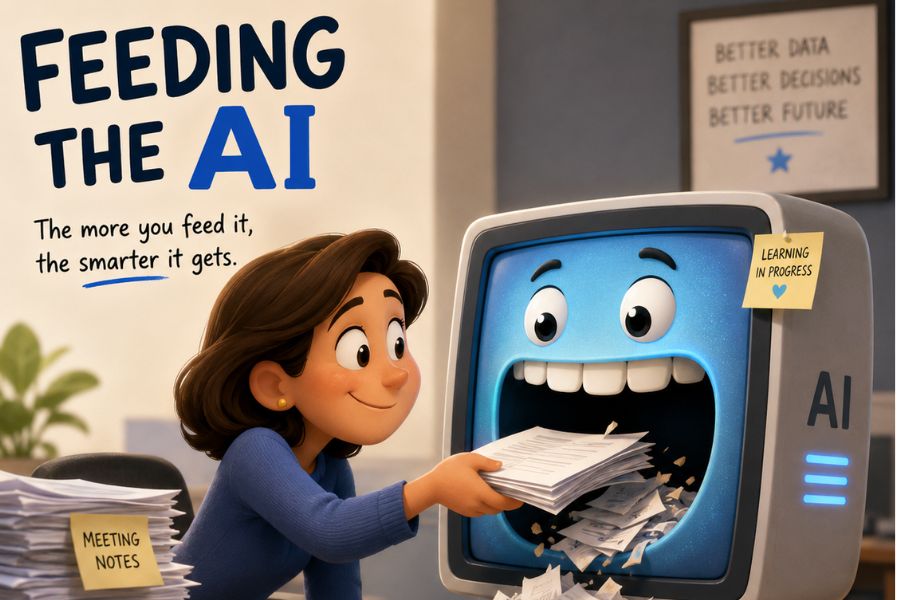
The out-of-the-box AI is almost useless.
Not because the technology is bad. Because it doesn't know anything about you — your organization, your members, your market, your people, your voice. It knows everything and nothing at the same time. It can write a competent sentence about almost any topic. It cannot tell you what your members actually care about, why your last campaign worked, or what your best customers have in common.
That gap is the whole game right now. The organizations that pull ahead won't be the ones with access to the best AI. They'll be the ones feeding it better.
Here's a shift that made me think about this differently.
When we built Zoom Connect — a tool that gets your Zoom recordings into a format that's easy to edit, share, and publish — we assumed people wanted the videos. The transcripts were an afterthought. Nobody asked for them. Nobody talked about them. The video was the asset.
That has completely reversed.
The transcripts have become more valuable than the recordings for many teams. Not because video stopped mattering, but because text is what you feed an AI. When you can drop a meeting transcript into a model and ask it to surface decisions, draft a follow-up, identify what got tabled, or flag who owns what — that changes how the meeting itself gets used. People started treating transcripts as working documents, not just records.
That's not a small shift. That's a whole new reason to capture something you were already capturing.
Now extend that logic beyond Zoom.
Every piece of video your organization touches is the same kind of asset. The session your keynote gave at your annual conference. The testimonials captured at your trade show. The member spotlight you published in March. The member who recorded a quick video about why she renewed her membership.
Each one is content. Each one is also data.
What does your community actually talk about when they're not reading from a script? What language do your members use to describe their problems? What does a long-term member say that a new one doesn't? What themes show up at every conference that never make it into your formal reports?
Right now, most organizations answer those questions by intuition, or by surveying people, or by paying someone to synthesize the qualitative feedback. That's slow and incomplete. But the answers are already in your video archive — they're just sitting there, unstructured, unsearchable, ungrouped.
AI changes that. Not automatically, not painlessly, but directionally. The organizations that are systematically capturing authentic video from their members, attendees, and speakers are building something that has a second life they may not have anticipated when they started: a corpus of real language, real perspective, real signal from the people who matter most to them.
The implications go further than insight retrieval.
The next phase — which is not far off — is hyper-personalization. Not "we segmented our email list by job title" personalization. The kind where the platform actually understands what a specific member cares about because it has heard them talk about it. Where a recommendation engine draws on what your community actually said, not on what your CRM fields suggest. Where your AI assistant, when helping you draft a membership renewal campaign, can tell you which arguments landed with which segment — because it has the transcripts to prove it.
That only works if you have the data. And the data starts with the video.
This is why I think video is more important now than it was before AI, not less. There's a reasonable argument that AI-generated content will flood the zone and make polished production less valuable. That's probably true for the kind of video that was always a proxy for credibility — the sleek brand film, the over-produced testimonial with the soft-focus background.
But authentic video from real people in your community? That gets more valuable, not less. Because it's the signal in a world that's about to be full of noise. Because it's data you can actually learn from. Because it's the thing an AI can use to get closer to what your people actually need.
Feed it generic inputs and it gives you generic outputs.
Feed it the real voices of your community and it starts to know something worth knowing.


