
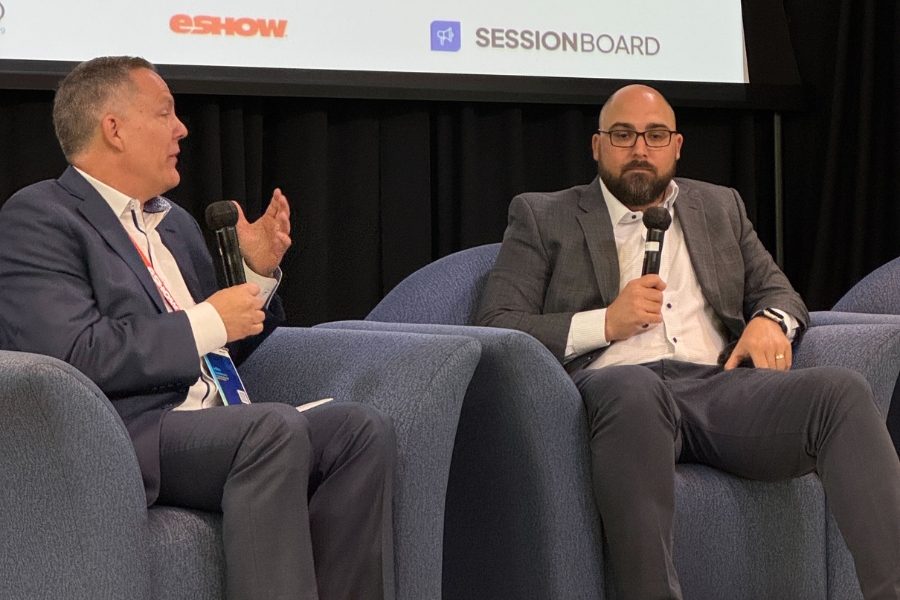
At the inaugural MeasureUP conference hosted by Bear Analytics in Washington, DC, the talk of the day was data, specifically how event organizers can use it to make smarter decisions. Sophie Holt, who led Bear’s first-ever Event Benchmarking Report, walked attendees through insights drawn from thousands of registration records across hundreds of events.
Her message was clear: after years of volatility, the event industry is not shrinking. It’s recalibrating.
“By 2025, average attendance numbers are only 4% lower than the year before,” Holt said. “That’s stability, not decline, and still far above pre-pandemic levels in many cases.”
One of the biggest takeaways was that the share of professional attendees, those who come to learn, network, and make purchasing decisions, has held steady at roughly 50–60% of total registrations. While raw numbers may fluctuate slightly, the quality of attendees hasn’t diminished.
Bear Analytics’ team used AI to filter registration data across more than 2,000 registration types, identifying the segments that matter most to event ROI. In other words, exhibitors might be seeing fewer people on the show floor, but those who are there are more relevant and valuable.
For event marketers, this is a key insight: targeting the right audience continues to deliver results. The challenge is ensuring those professionals show up and continue to see value.
This is where technology like Gather Voices aligns with Holt’s findings. When the high-value segment of attendees is smaller but more engaged, authentic storytelling becomes critical. Encouraging attendees, speakers, and exhibitors to co-create short videos before, during, and after an event helps extend engagement and prove value to sponsors long after the show closes.
Another encouraging trend: the percentage of paying attendees is increasing. From 2022 to 2024, about 30–39% of attendees paid for tickets; in 2025, that number rose to 43%.
Even as average ticket prices softened slightly this year (to just over $600), the shift toward paid attendance has kept overall revenue streams resilient. Holt noted that this stability is particularly notable given broader economic headwinds.
For organizers, this means they can and should continue to invest in programming and experiences that justify a ticket price. It also underscores the importance of communicating that value early, since late decision-making remains a persistent concern.
One of the few areas showing real decline is group attendance from larger organizations. In 2023, the average company sent 2.4 people to an event; by 2025, that number had dropped to just over two.
More strikingly, the share of large delegations (six or more attendees) dropped from 23% to 19% year over year.
“Companies are sending smaller, potentially higher-quality delegations,” Holt explained. “They’re relying on those individuals to bring insights back to their wider teams.”
This change has real implications for how organizers deliver and share content. Smaller delegations mean fewer people experiencing sessions live, and more pressure on organizers to provide on-demand video and digital summaries so knowledge can circulate internally.
Gather Voices customers are already responding to this trend. By equipping attendees with tools to capture short, meaningful videos on site, organizers can help those smaller teams bring the event home, literally amplifying learning and ROI across their organizations.
A common refrain among planners is that attendees are registering later and later. But Holt’s data challenges that assumption.
Bear Analytics found that last-minute registrations, defined as those within two weeks of the event, have stayed remarkably stable at 21% for the past three years.
That doesn’t mean marketing teams can relax. Holt cautioned that travel costs and logistical barriers may still be discouraging some late registrants from actually attending. “If they haven’t planned early, they simply don’t show up,” she said.
The takeaway: campaigns that rely too heavily on a last-minute registration surge could face greater risk. Event marketers should front-load urgency earlier in the cycle, using clear deadlines, early-bird incentives, and importantly, authentic social proof from peers.
Short videos from past attendees and speakers are one of the most effective ways to drive early registration. Real people saying why they’re attending again, or what they gained from last year, outperform polished promo reels every time.
On the exhibitor side, growth has slowed after the post-pandemic rebound. The number of exhibitors has flattened, but revenue from exhibitors and sponsors continues to rise, up 11% year over year.
Why? Because exhibitors are reallocating budgets. Instead of investing in ever-larger booths, Fortune 500 companies are shifting toward sponsorships and creative activations that drive visibility and engagement beyond the show floor.
“Success with major corporates will come from offering flexible, creative activations that align with their strategic objectives,” Holt said.
This trend plays directly into the strength of video-driven engagement. Whether it’s a sponsored StoryBooth where attendees record testimonials or an exhibitor activation that generates shareable content, the ROI now depends on what happens beyond the booth.
One un-surprising data point, given the crazy situation with the current US administration, was the sharp drop in government participation. Using .gov email addresses as a proxy, Bear Analytics found a 69% drop in paid government attendees from 2024 to 2025. While this group represents only about 1% of total attendance, the decline underscores how budget and policy shifts can ripple across the ecosystem.
For shows that rely heavily on public-sector attendees, Holt advised resetting expectations and outreach strategies accordingly.
In closing, Holt summarized what the data really tells us:
“The industry isn’t collapsing, it’s recalibrating. Growth has cooled from its post-pandemic peak, but audiences and exhibitors remain engaged, and revenues are holding steady.”
For event organizers, the path forward is clear. Build deeper relationships with existing organizations to encourage larger delegations. Create urgency earlier in the registration cycle. And offer exhibitors activation opportunities that go beyond booth size.
For companies like Gather Voices, the report reinforces a central truth: the most valuable metric isn’t just how many people attend, but how many connect, share, and amplify their experiences. As events evolve, authentic video storytelling remains one of the most measurable ways to prove engagement and keep that recalibration moving in the right direction.


