

Skift Meetings editor-in-chief Miguel Neves led a lively session at IMEX on how AI is changing events. What made it useful was not another product parade. It was a clear-eyed look at where AI is helpful now, where it misleads, and how to fold it into real workflows.
Neves started by setting expectations. “I’m here to offer you a sort of balanced view,” he said. “I’m not here to say buy AI. I’m here to show you what’s good, and maybe what’s bad as well.” That frame anchored the next two hours.
A recurring theme was the hype cycle. Neves asked the room where we are on Gartner’s curve. Many felt we have passed the peak of inflated expectations and are sliding into realism. That resonates. The past year delivered jaw-dropping demos and a flood of AI press releases, but also some clear real-world applications that are having an impact at Gather Voices and many other companies.
He highlighted the rapid leap in image generation quality. His first Midjourney image looked like a novelty. A recent one, depicting a female emcee introducing a speaker, looked polished enough for a brochure. Yet a trained eye spotted a tell: “there’s no microphone on the speaker.” The lesson is basic but important. AI can now produce on-brand visuals fast, but domain knowledge is still required to catch subtle misses.
Trust surfaced repeatedly. Neves cited a cultural shift among kids who use “AI” as a synonym for fake. One quip from a classroom captured it: “I don’t believe you. That’s AI.” He also referenced public backlash against a wearable “AI companion” marketed as “someone, not something.” Whether or not those products succeed, the sentiment matters. If audiences equate AI with inauthentic content, event marketers need strategies that put real people and verification front and center.

The session moved from ideas to practice with a stand-up exercise. Participants self-sorted by AI optimism, trust, and integration into daily work. Most use general models like ChatGPT, Claude, or Gemini for writing and research. Far fewer use event-specific AI features inside platforms. One attendee shared a concrete win: hosting webinars inside their own site with an embedded platform, then using transcripts to generate clips and first-draft blog posts that a human editor finishes within 24 hours. Another noted how AI helps tailor proposals to a prospect’s voice only after the writer sets the strategy. The pattern is consistent. AI accelerates, humans direct and verify.
Neves ran a quick quiz to reinforce the basics. “Why is human oversight important when using AI?” Because it makes mistakes. “What do we call those mistakes?” Hallucinations. “Why is bias a concern?” Because models reflect patterns in the data they are trained on. The message was not fear. It was governance. Do not put sensitive data into free tools. Know your guardrails. Document how you fact check, attribute sources, and approve outputs.
He also summarized research on how people actually use AI now. The top band of use cases is practical guidance and how-to help, from fixing a sink to cooking. Summarization and information gathering are next. Technical help sits below that, and pure self-expression lower still. For event teams, this maps neatly to real jobs to be done. Draft emails. Outline agendas. Research venues. Summarize sessions. Generate first-pass visuals. Then apply human judgment, brand, and compliance.
Here is where I connect the dots to Gather Voices. Our north star is authentic video from real people, captured and delivered with less friction. The credibility concerns Neves raised are exactly why we lean into co-creation and transparent workflows. Audiences are wary of overproduced or synthetic content. They respond to genuine voices from peers, speakers, and attendees. AI is useful in our stack when it speeds the work without erasing the human.
A concrete example is our AI StoryBooth. As I shared in the room, participants step in, an AI interviewer asks event-specific prompts, and we automatically turn each recording into a tight social clip. The AI does not invent quotes. It helps with pacing, trimming, captions, and packaging. Editors still review. Organizers still control prompts and brand elements. This mirrors the best practices Neves pushed: integrate AI where it reduces toil, keep humans in the loop, and measure outcomes, not buzz.
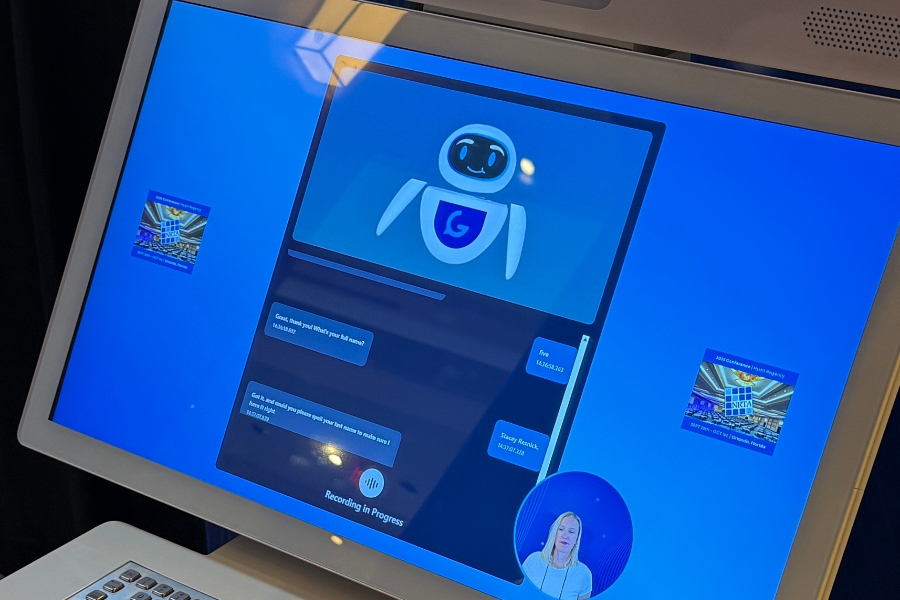
In short, our approach at Gather Voices aligns closely with the principles Neves emphasized.
Neves closed the pre-break segment with a slide of ten event use areas where AI already helps, from marketing content to operations. The take-home was pragmatic. Start with one or two tasks where AI can save your team hours this month. Document how you review outputs. Share wins. Then expand.
AI in events is not a silver bullet. It is a power tool. As Neves said, the goal is the “plateau of productivity,” where AI is integrated into everyday work. For event marketers who care about authenticity and speed, that plateau looks like more real stories from your community, delivered in less time, with your team firmly at the helm.


